For parents
You're not imagining it.
And it's not your fault.
If school has become a battle and you can't work out why your bright child struggles with reading, this page is for you. Plain answers, no jargon, no judgement.
The signs
7 signs your child may learn differently
- Confuses similar letters — b/d, p/q — well past the age classmates stopped
- Can retell a story brilliantly out loud, but can't read or write it
- Spelling learned on Monday has vanished by Friday
- Avoids reading aloud — "I'm tired," "It's boring," tears, tantrums
- Homework takes hours and ends in frustration for everyone
- Teachers say "lazy," "careless," or "not trying" — but you know they try hard
- Their confidence is shrinking: "I'm stupid," "I hate school"
Three or more of these? Your child may have dyslexia or another learning difference — which says nothing about their intelligence and everything about how they need to be taught.
The truth about dyslexia
What it is — and what it is not
Dyslexia is not…
- laziness, low intelligence, or "not trying"
- something a child grows out of if you just wait
- fixed by more of the same drilling that already failed
- a life sentence of struggle
Dyslexia is…
- a different wiring for processing language — often alongside real gifts in creativity, empathy, and big-picture thinking
- very common, and very responsive to the right teaching
- best met with structured, multisensory, step-by-step literacy
- the reason your child needs a different path — not a lesser one
Start tonight
Three things you can do at home this week
1
Retire the labels
Say it out loud to your child: "You are not lazy. You are not slow. You learn differently, and we're going to find your way." It matters more than any worksheet.
2
Read to them, not at them
Take the pressure off decoding. Read aloud together for pleasure so books stay a place of warmth, not fear, while the skills are rebuilt properly.
3
Catch them being capable
Name one real strength every day — building, drawing, kindness, ideas. Confidence in one area is the bridge back to confidence in reading.
Free guide
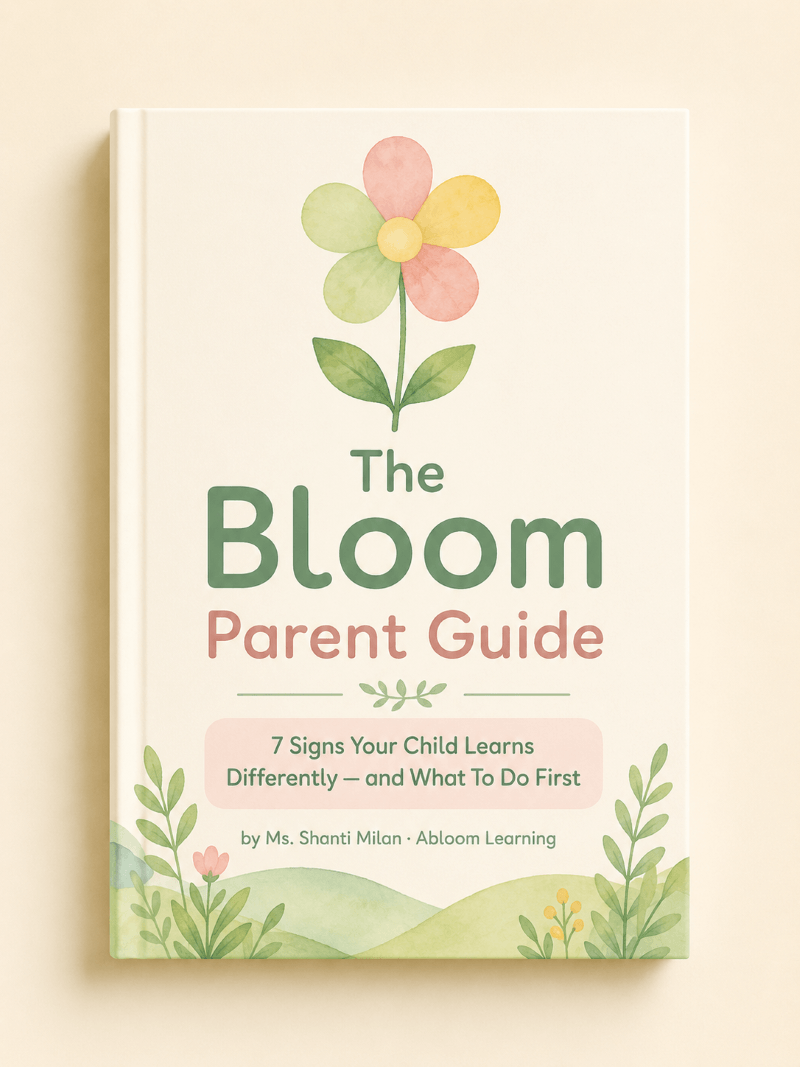
The Bloom Parent Guide
"7 Signs Your Child Learns Differently — and What To Do First." A short, warm, practical guide by Ms. Milan Daryanani: how to recognise the signs, what to say to your child, how to talk to the school, and the first steps that actually help.
WhatsApp "GUIDE" to get it freeSent free on WhatsApp. No spam — just help.
Worried-parent questions
You are allowed to ask anything
Is it my fault? Did I miss something?
No. Dyslexia is neurological — nothing you did or didn't do caused it. And you haven't "missed it": the fact that you're reading this page means you're doing exactly what a good parent does. Support that starts today changes everything.
Should I get a formal assessment first?
An assessment can be valuable, but you don't need one to start helping your child. The free discovery class gives you an experienced read on what's happening, and we can guide you on whether and where to seek formal assessment in Malaysia.
Will my child ever read normally?
With structured, multisensory teaching, children with dyslexia learn to read, write, and thrive — many spectacularly. The path is different, not closed. What they need is the right method, early support, and an adult who believes in them. That can start this week.
Let's meet your child — not the label.
Book a free discovery class. Ms. Milan Daryanani will spend it getting to know how your child learns best, then tell you honestly whether the programme is the right fit.
Book a free discovery class on WhatsApp